

what is Fiber optic backlight?
Fiber optic backlight are a woven fabric of thin plastic strands that form a very thin, flat sheet. All of the strands in one axis exit one edge of the flat sheet and are gradually bundled into a tight, round end that is secured with a metal ferrule. The end of the fiber optic bundle is illuminated with a bright lamp. The light travels along the individual plastic strands as the reflective angle of the light is too small escape the strand. When the light reaches the woven part of the flat lamp, or the illuminated area, the radius of the weave creates a larger reflection angle allowing some of the light to escape. The fiber optic lamp is really a misnomer as the plastic strands act as a light pipe, not the light source. The surface of the fiber optic lamp is cool to the touch as the light source is remote from the surface of the lamp.
The fiber optic lamp illumination is very even. Color and brightness is controlled by the light source at the end of the fiber optic bundle. Constraints on light source size are virtually eliminated because the light source is not part of the user interface assembly.
Fiber optic lamps have some significant constraints due to their construction. Through holes in the illuminated portion of the woven fiber optic lamp block light on the opposite side of the through hole from the light source end. There is no light path around the hole. The geometry of the light pipe dictates that the fiber optic lamp width can narrow across the face of the lamp moving away from the light source end but fiber optic lamp width cannot increase across the face of the lamp moving away from the light source.
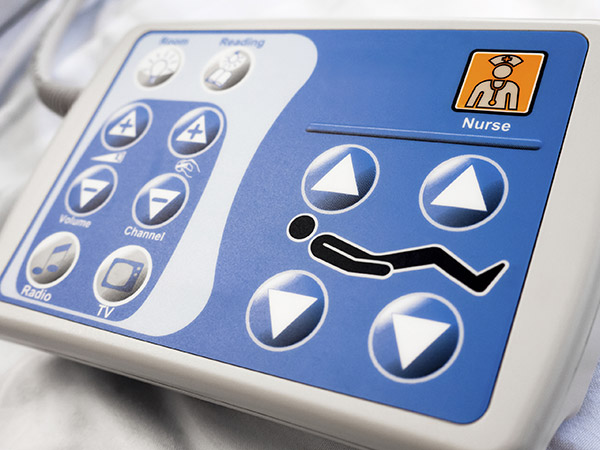
There is one other type of general backlighting technique that is available but doesn't lend itself to backlighting user interface keypads. That technique uses a plastic panel that is edge lighted with LEDs. Edge lighted panels are used often to backlight liquid crystal displays (LCD). The panel surface is molded or etched with a pattern that redirects the edge light traveling along the plastic panel toward the front of the user interface keypad. The edge lighted panel is not being considered in this article because the plastic panel is not flexible and must be mounted behind the user interface keypad. Various opaque parts of user interfaces prevent shadow free general backlighting.
Fiber optic backlighting offers several benefits, one of which is energy efficiency. Even when fiber optic is used with LED, it’s still one of the most energy-efficient backlighting solutions available. You can expect fiber optic backlighting to draw just 20 to 50 mA of power. That makes it a smart financial investment, as it lowers the cost of businesses’ electric bills.
Not only is fiber optic backlighting energy efficient, but it also has a long life expectancy. A typical LED-powered fiber optic backlight will last for 100,000 hours. This means businesses will spend less time, energy and money replacing blown backlight bulbs or the devices in which they are installed.
Of course, fiber optics are only one option to consider when choosing a backlight. Other backlighting solutions include LEDs and electroluminescence (EL). Fiber is certainly an attractive option given its energy-saving properties and long life expectancy, but businesses should consider all options to determine which backlight technology is right for their needs